Sunday, January 16, 2011

Great Expectorations


Had a really nice chat with Tim Coles, Cali honcho of The Grateful Palate, an Australian-based network of assorted worldwide wine labels and brands. The brands and labels sheltered by the Palate bumbershoot changes, ebbs and flows, but it’s all good when an Aussie label deigns to give love to our ‘hood, even if only fleetingly.

You must be sick of us writing about the Evangelho Vineyard, up north of us in Antioch.

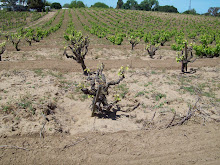
Owner Frank Evangelho now lives in Pismo Beach, hundreds of miles south of the vineyard. But here’s the deal: Frank Evangelho always seemed to find a block of great old-vine Carignane or Mataro that wasn’t booked to a major client, and that could find its way into a garagiste’s effort. Dave Parker got the call for his Parkmon label, and I’m guessing that winemakers Doug Danielak and Chris Ringland from R Wines must have received a similar Bat Signal for the 2006 harvest.

“R Wines” is a bit of a tentative label under the Grateful Palate ‘shoot at this point in time, and the suspicion is that R may, or may not, make way for something bigger. In the meantime, in between time, ain’t we got fun checking out this CoCo wine from the neighborhood?

R released a couple of Evangelho Vineyard wines in 2006, their last vintage from this property, though, as Tim says, “Never say never.”

“Amaze” from 2006 is 100% Evangelho Mourvèdre, while the 2006 “Amazed” is a 50/50-blend of Mourvèdre and Carignane from the Evangelho property. That’s the one that Kathy found on Wine.com. It was spendier than other Evangelho bottlings we’d searched out from other producers, but, like land, they’re not making it anymore. And, with this being the year 2011 already, this baby has almost a half-decade of age on it already. R Wines’ 2006 “Amazed” California exhibits a deep blue/black color. On the nose, it’s scented to plum and other red stone fruit, with notes of tar, tobacco and cedar. The palate notes a real elegance and purity of balance that’s different from other Evangelhos we’ve tasted from other producers, with lots of smoky wood on a long, long finish. It’s 16.5% alcohol, surprising considering the wine’s refinement in the glass. Come back soon, Amazed.

Sunday, January 9, 2011

Dead End


Since we started this blog last April, Kathy and I have made a few interesting discoveries about the grapes and growers around Oakley, and we’ve drunk some delicious wines made from our local fruit from these century-plus aged old vines. We’ve had some revealing interviews with some of the growers, and it’s been fun to track down some bottles made by the winemakers to whom these growers sell. “Drinking our way through the neighborhood” is our term for this little endeavor.

But we’re starting to get to a point several months into this thing wherein the leads start to dry up and the investigation, as it were, slams into the proverbial brick wall. We have several bottles in our cellar containing wine made from CoCo grapes, but in a couple of instances, I’m having a heck of a time getting someone from the particular wineries to return my calls or e-mails.

Such is the case with Trinitas Cellars, a label I’ve written about a few months back. Trinitas was started by Matt and Erin Cline, in partnership with Tim and Steph Busch and Ray and Bette Rodeno, when Matt left the family biz, Cline Cellars, to go out on his own as winemaker. As noted in past posts, Matt and Erin sold out their interest in Trinitas to current owners the Busches, and went on almost immediately to found 3 wine company, which Erin and Matt run today.

We have at least four bottles of Trinitas varietal wines made from Oakley grapes, and I can’t get anyone on the phone to talk to me about them. Trinitas even has a national sales manager, my messages haven’t been returned. Ah well, c’est la vino!

Our Trinitas bottlings are from the 2006, 2005 and 2004 vintages, with the ’04 bearing Matt’s winemaker signature on the label. The later two vintages bear those of Tim and Steph, as the then-new proprietors. But based on the timeline of the buyout — Christmas 2006 —, with the ‘05s in the barrel and the ‘06s in the tank, it’s pretty clear that Matt made all these wines before transferring his stake.

I’d love to hear from someone at Trinitas about any changes post-sale. Matt, of course, is so passionate about Oakley fruit that I wonder if the new regime still sources from growers around here.

In the meantime, it’ll have to suffice for us to blow the dust off a bottle of Trinitas Cellars wine made from old-vine grapes by the old guard.

The Trinitas 2004 Old Vine Mataro is an Oakley love-fest blended with single-digit percentages of Black Malvoisie (an old-skool synonym for Cinsault), Petite Sirah and Alicante Bouschet. In the Riedel, it’s all deep, though translucent, cranberry. The Ocean Spray vibe continues on the nose, joined by whiffs of blueberry and spicy cocoa. The mouthfeel echoes the nose, with lots of tart, superbright small-berry fruit. There’s nice balanced acidity with a touch of earthiness on a subtle medium-length finish.

Sunday, January 2, 2011

Absinthe, You’d Better Make This Heart Grow Fonder


See ya, Old Man 2010; don’t let the door rupture your colostomy bag on the way out.

It’s late morning on December 31, 2010, and I’m here at the keyboard, reflecting, sans vino, on the past year. A few local vineyard mysteries solved, some nice wines from local grapes drunk; but, man, what a year of upheaval. Kathy has worked for three companies this year alone: the firm that relocated us to Oakley from Seattle in the summer of 2009; another company that cut her medical benefits the day she lost her job; and her current employer: a much more prestigious company, but the gig came with a cut in pay and benefits.

Our city of Oakley in East CoCo County is the literal “suburban bedroom community.” It’s a commuter’s Mecca, if by “Mecca” one means bowing one’s head to the steering wheel five times daily and, raising one’s head to the vehicle’s roof, loudly exhorting to your deity of choice. Highway 4 sucks, but it’s the only game in town. The Bible, Torah or Quran just doesn’t seem to help, no matter how long you scream into the sun visor at rush hour. And in our locale, much as city government would like to bolster local business, the reality is that any available gigs are in the retail sector. Not much call for a former stand-up comic, magician (past lives) or, (most recently), advertising copywriter, editor and prufreeder. Samples avale-able on re-kwest, natch.

2010 saw Kathy hear from old friends in Utah who are justthisclose to losing their house to foreclosure.

2010 saw our Seattle-area Woodinville wine pals, who, if Kath and I were feeling blue, would send a “Wine tasting tomorrow?” e-mail at just the right time. We found out that one of them lost their job due to the proverbial economy. They bought us a Didier Daguenau Sauvignon as a parting gift last year. The plan, as always, was to share it with them in our new house, but do not know when that can make economic sense for anyone. FYI: It’s still chillin’ at das crib, guys.

2010 saw other friends lose their dream ranch in Eastern Washington, where they were raising goats, chickens and a new baby daughter. Job precariousness necessitated their putting the homestead up for sale and relocating back to the other side of the Cascade Mountains, on a scaled-down version of their dream in suburban Woodinville.

2010 saw our neighbor, an investment banker no less, list his former model home on MLS as a short sale.

Working in SF, Kathy happened to pick up a couple of tickets that the Bay Area Rapid Transit (BART) system was handing out at select stations. These were Sat/Sun-only tix, designed to encourage folks to come to the city just before Christmas. BART’s fares are mileage-based, like London’s Tube, but these tix were good for a one-way excursion, regardless of distance. Ever since leaving the Pacific Northwest last year, we had been jonesing for oysters. We’d been disappointed that any seafood in the East Bay had been “frozen for quality” when Seattle salmon was being given away up north. Heck, even the local “oyster bar” in Brentwood offers only the dinner-plate-sized Pacifics.

December 18, we drove to BART and rode to SF for three-dozen raw Olympia oysters and a bottle of Muscadet sur-lie. Absolutely glorious. Missed that so much.

We jumped on the Alameda ferry; the terminus is minutes from Rosenblum Cellars. St. George Spirits used to be located right beside the Rosenblum crib. They are not now. We disembarked the ferry and walked for 20 minutes to the new distillery, now call Hangar One for their eponymous Vodkas. We did a tasting, and the purity of the infusions is exquisite. We paid a little extra for the tasting of their “Absinthe Verte.”

Historically, Absinthe is that funky spirit infused with the dreaded herb wormwood which contains a supposedly addictive drug known as “thujone,” affecting such subversives as Baudelaire, Modigliani, van Gogh and Oscar Wilde. Bartender, see what the boys in the back room will have! By 1915, it was banned almost worldwide.

In the last month of 2007, St. George became the first American-made Absinthe manufactured here. It’s a gorgeous bottle sporting an oldee tymee apothecary label touting its contents as “Fine Brandy With the Choicest Herbs,” including star anise, mint, lemon balm, hyssop, meadowsweet, basil, fennel, tarragon, stinging nettles, and, last but not least, the storied, previously banned, wormwood. I’m more worried about the stinging nettles, but after 2010, am more than ready for wild imaginings.

Monday, December 27, 2010

Not a Creature was Stirring …


That’s because building the cocktails is my job!

Sorry for the sucky Christmas Day photo of our 17-year-old, kitty chemo patient being comforted by my hand-knit sock monkey present from Santa. Yeah, it’s a bit “Tiny Tim, ‘Deity of your choice’ bless us, every one,” but as we’d just watched “The Muppet Christmas Carol” the night before — the only version of the Dickens classic that Kathy can stomach, BTW (love the in-jokes, especially the sign on the building in the background, “Micklewhite & Co,” a nod to Michael Caine’s real surname) — well, ‘tis the season for treacle and suckiness.

In the decades that Kath and I have been together, we’ve whittled our Christmas traditions down to a few standards of presents, rituals and meals for the holiday season, since it’s just the two of us. It starts with a de rigueur viewing of the Pee-wee’s Playhouse Christmas Special on Thanksgiving, putting up the tree mid-December and an obligatory Christmas morning gift exchange of brand-new flannel pajamas and two-player board games.

Christmas meals have been similarly honed to delicious regimen. We’ll have a Dungeness crab pasta dish on Christmas Eve, and, invariably, a slow-cooked salmon fillet plated with a chunky, spicy cherry/jalapeño/lime/cilantro salsa for Christmas dinner. I grew up in Canada with the stuffed turkey thang (of course, Canuck Thanksgiving is the first Monday in October; as a kid, I could never understand “Miracle on 34th Street” with Santa at a Thanksgiving parade.), so it came as a big surprise to me when our unique and contrarian Christmas meal plan would, in the last few years, often result in Costco, of all places, running out of salmon and/or Chilean cherries. And now that we’re in the far East Bay of Northern Cali, as opposed to Seattle where Kumamoto oysters are virtually on tap, the hunt for fresh salmon and crab, never mind out-of-season cherries, required Kathy to plan our December 24 grocery shop with military precision.

Since the Asian market in Antioch closed this summer (their landlord went into foreclosure), our source for live crab dried up; we’d have to hope that our local outpost of the Raley’s supermarket chain had cooked Dungeness available, since the weekly circulars made no mention of it. Kathy set the alarm for 7 a.m. Christmas Eve, and while I ground the coffee beans, she pored over recipes for new side dishes, and made the list for our classics. And, yeah, she did check it twice.

Before jumping in the shower, she had me call Raley’s to see if they had crab. “Yes, ma’am [I have that kind of voice],” Bob the pleasant seafood manager told me, “and we have plenty.” Kath was still nervous, and we soon hit the road, with the supermarket our first stop. We split up once inside: Kathy to get crab and chicken livers (sautéed in raspberry vinegar with crème frâiche makes a heavenly breakfast), I to try to find cherries. All kinds of imported berries in those plastic clamshells, but no cherries; then, as I was about to give up, I spotted zipper bags of imported cherries beside the grapes. $6.99 per pound, but we’d been burned by Costco before. I grabbed a bag and reconned with Kath.

Next stop: Costco. Last year, we thought they opened at 11 per our membership level; they had opened at 10. This year, we got there shortly after 10 only to discover that they had opened at 9. Kathy went salmon fillet fishing; I hit produce to check for cherries. Good thing we found them at Raley’s; Costco had none. They were even out of limes. Luckily, I’d stocked up on citrus earlier in the month; we did not want this to be the Year Without a Margarita. Plenty of salmon and steelhead, though. As we’ve done for the last few years, we bought an extra fillet to smoke on Christmas Day in our Big Chief electric smoker.

Final stop: Trader Joe’s, for all those funky little gourmet extras, such as haricots verts and Meyer lemons. There’s a relish from one of Alice Waters’ Chez Panisse cookbooks that uses Meyer lemons, but this year, we’ve decided to use ‘em for Lemon Drops.

Hope y’all had a nice December 25; Kath and I did. Christmas jammies and board games, chicken livers and board games, a round of afternoon cocktails while listening to a Kevin Pollack Chat Show podcast, a slow-roasted salmon fillet with blueberry-cherry salsa and green beans with bacon vinaigrette, and paired perfectly with a 2009 “Vin Gris of Carignane” from 3 wine company.

It’s a rosé from CoCo grapes that preens a beautiful salmon color, appropriately enough, considering the food pairing, with tints of strawberry fruit and cranberry juice. The nose is all floral notes of cherry, rose petal and that ubiquitous cranberry. There’s nothing subdued about the mouthfeel, echoing its darker coloring: lots of cane berry fruit and bashful acidity providing a long finish. It’s a rosé in no way content to hide in the shadows of the genre.

Sunday, December 19, 2010

Last Train to Clarksburg


Kathy and I gassed up the “Lisa Marie” last weekend and motored east along the Delta levees to The Old Sugar Mill in the town of Clarksburg, CA, for the release party of two 2008 CoCo Zins from Matt and Erin Cline’s 3 wine company.

I’ve mentioned this previously, but over the last decade or so, Kath and I have belonged to dozens of winery-specific wine clubs. At one point, when we lived in San Francisco, I suspect that our deliveries were singlehandedly paying the UPS guy’s salary. But moving up and down the West Coast over the years, our affiliations with particular terroir often altered, and then, no longer being natives, the sense of pride of membership in a truly “local” wine club dissipated. We often canceled after leaving the area.

Seattle was a wild wine club ride for us. For starters, this last Seattle return, like a Cher “Farewell Tour,” was the longest we’d ever spent at one address in years. Pre-computer-address-book, anyone looking up our phone number in their personal log would have been met by a Dead Sea Scroll of paper fibers barely holding together under the rigors of eraser and deletions. But when it became apparent that we might just stay put up here, visiting wineries, and signing up for their clubs (still kind of a Washington state novelty in 1999), became a logical extension of our Cali experience.

For Kathy and me, the subscription always began with an inaugural visit to a tasting room hosted by someone who was chill, funny and knowledgeable. Hell, yeah, we’re going to buy a bottle from you; might as well get the 20 percent disco right now, in exchange for your hitting the credit card every quarter! And then, as a club member, you make a return trip, expecting the love, and that exact same pourer sees you. But not only do you get no greeting, but he/she is working so hard to avoid eye contact with you that you swear you can see saline solution squirting from their sockets.

And don’t get me started on the wife of the Woodinville-based-winery owner who actually telephoned me to ask if we would cancel our reservations to their winemaker dinner, so that she could make room for guests of her choosing. I gladly canceled both reservation and membership in their wine club.

The coolest wine club north of Seattle? It’s actually the one run by a huge conglomerate. Chateau Ste. Michelle knows how to do it right, man. They are big, but we have been seeing the same friendly faces — hello, Margaret; hello Mary Kay — greeting us for years. Doing something correctly for customers and employees, ya think? Kath and I moved back to Seattle in ’99, and we did not have a car until 2002. One of our signature moments at that time was to phone Ste. Michelle to say that we’d like to cancel UPS deliveries and go “Will Call.” It was the perfect excuse to taste and tour around Woodinville, but CSM was always the civilized spot: private tasting area for club folks, tours if you wanted, your guests welcomed wholeheartedly, and an annual, wine-soaked, free concert (recent performer Natalie McMaster) for club members.

But please don’t get me started on the wife of the other Woodinville-based-winery owner who actually telephoned me to ask if we would cancel our reservations to their winemaker dinner, so that she could make room for guests of her choosing.

OK, so where am I going with this wine club thang? Well, I know that I posted a while back about our financial boot to the head, and how we canceled ‘em all, including, regretfully, CSM (maybe part of that “we don’t have ties to WA state anymore” vibe I alluded to earlier). But, a couple of months ago, Erin Cline invited us to a release party, and Matt’s wines are so evocative of his ties to our new CoCo ‘hood, that we had to join their “Dirt” wine club.

They are 3 wine company; we are now members of only 1 wine club. Theirs.

The 2008 three Zinfandel Old Vines Contra Costa County is a local ‘hood blend comprising a bissel Carignane, Mataro and Alicante, but a double-digit-dose of Petite. At 18 bucks, it jams with youthful blue color, baking spices (Kath is talking clove, cinnamon) and we both hipped to a white pepper vibe. I got a bunch of dried fruit, acid and pepper on a good finish.

So now, Matt has released a 2008 Zin from Frank Evangelho’s property. I love when we see the same vineyard names cropping up; it makes me feel that it’s real property, unlike “Driving Range.” Man, that would have been such a great moniker if someone had actually staked it out. Das Frank exhibits some inky raisin, with a nose of spicy blueberry and a touch of eucalyptus, with pepper grains and a bit of tannin on the finish.

Sunday, December 12, 2010

The Rhône Arranger


No one wants to be a pioneer. Whether being the first person to restore a craftsman house in a dodgy ‘hood, or being a winemaker placing all his or her (oak) chips on the next big grape variety to spark a consumer frenzy, it’s downright scary to be first in line leading with your chin.

That’s why it’s so hard to remember that, once upon a time, the notion of introducing the North American wine-drinking public to such exotic varietal grapes as Syrah, Grenache and Mourvèdre would have been met by a Frankensteinian reaction along the lines of, “You haff toiled mit sings zat man vass meant to leef alone!”

And one of the first winemakers to raise the lightning rod and jolt American imbibers’ neck-bolts was Randall Grahm, the erudite, passionate, mercurial honcho of Bonny Doon Vineyard. There’s been a lot of grape juice under the bridge in the intervening decades since Grahm was deemed the de facto leader of a spirited pack of west coast vintners dubbed “The Rhône Rangers” for their zeal for all grapes Southern France, and the moniker does seem inseparable from the man, to his mild dismay. Truth is, dude has reinvented his Santa Cruz-based Bonny Doon winery repeatedly, and the alterations and expansions show no signs of letting up. I had a chance for a telephone chinwag with Randall Grahm to get some insight into wine in general, and Oakley fruit, with which he has a longstanding familiarity, in particular.

Cardinal Zin, Big House Red, Old Telegram, Cigare Volante, Pacific Rim: Homes has created (and often sold off) more branded product than Outback Steakhouse. And RG’s tasting notes and D.E.W.N wine club newsletter are packed with perspicacious, alliterative prose so dense that it sometimes makes James Joyce’s “Ulysses” read like a “Garfield” strip. And yet, the man knows where the bodies are buried when it comes to sourcing fruit up and down the West Coast.

Kath and I had first encountered the Doon when we’d moved to Seattle (the first time) from Los Angeles in 1991. We were both partial to big red wines, but were intrigued by Cigare Volant (its “flying cigar” nomenclature giving props to a report of a Rhône UFO sighting a long time ago), a lighter-style red available at the Pike Place Market Cost Plus for a then-budget-busting-for-us $18.99.

And, it turns out, a lot of the Cigare grapes were grown right beside the Oakley post office, a few miles from our current house. It also turns out that Randall Grahm has long had an on-again/off-again affair with CoCo growers. They’re all farmers here, much to my chagrin; I’d love to see some old-viners get in the winemaking game, either directly or via hired consultants. One might think that at 100+-years old, the vine is gonna do what that vine is gonna do. Apparently, RG got into a whole pile of steaming when he pruned entire clusters of grapes off of these already-stingy gnarls. The growers, paid by the yield, were not happy.

Oakley has “wacky soil,” he says. And, through pruning and some irrigation, “I’d just like growers to step it up.” His Twitter account unabashedly and no doubt apocryphally limns the McDonald’s at which he and British wine writer Jancis Robinson allegedly dined in Oakley.

He stopped making his Rhône -style “Vieux Télégraphe” homage, a Mourvèdre-based “Old Telegram” from Tom Del Barba’s Oakley grapes, years ago. As his original estate succumbed to blight, plans for a Central Cali Valley estate foundered, and his WA state Riesling project seems sometimes to be a mere distraction for him.

Randall Grahm wants to continue to create “interesting, kick-ass wines.” There’s no reason to think that this terroirist can not continue to innovate and be energized; he’s currently planning a totally biodynamic spinoff operation. This pioneer certainly doesn’t need any blogger from Oakley to validate his eonophilic ambition.

Of the many Rhône varietals Grahm has championed, Carignane is the one he’s most resolute about being criminally undervalued, and that its potential for true elegance is too often ignored. Bonny Doon puts out a red blend titled “Contra,” the 2009 of which holds a majority interest invested in Carignane, and the rest a veritable dog’s breakfast of Grenache, Mourvèdre, and single-digit percentages of Petite, Zin and Syrah. The fruit is sourced from both the Bien Nacido Vineyard way south in the Santa Maria Valley, and a property owned by the Gonsalves family and located just north of us on the other side of the driving range. I wrote about this site a couple of months ago, after I had dropped by the vineyard to discover harvesting about to begin. This is the property located on a dead-end beside an empty new business park, and which frequently serves as a dumping ground for unwanted items. The harvest crew chief told me that they once found a derelict sofa among the old vines, and that Randall decided to feature it on the “Contra” label.

Well, recently, Kathy was able to rustle up a bottle of Bonny Doon 2009 “Contra,” and there it is: a white (-ish) loveseat, front and off-center against a background of gnarly, neatly pruned old vines. In the glass it’s a bright translucent Bing cherry color with deep reflections of blue around the edges. At the nose its Beaujolais-like perfume emits whiffs of cherry cola and red currants. It’s nimble across the tongue, too: spicy blueberry notes with hints of tannic “fur” on the sides and roof of the mouth, and balanced by nice acidity on the lengthy finish.

Randall Grahm calls his Contra bottling “a field blend that contravenes contraindicated conventions.” Much like the man himself: a winemaker often contradistinguished by his very contradistinction.

Sunday, December 5, 2010


I know that we’ve written previously about the Livermore Valley, located about a half-hour south of us here in Oakley. It’s an area with quite a storied wine culture, with a couple of big wineries, Concannon and Wente, having been the “anchor tenants” of this region for decades. Years ago, the region even got its act together to petition for its own Livermore American Viticultural Area (AVA). The petition was granted, and that puts them miles ahead of our area of old-vine plantings; I’d love to see Oakley getting some label love similar to Livermore’s. Grrrrrr.

The first weekend in December, our southern neighbor throws open the proverbial doors for the Livermore Valley Wine Country “Holidays in the Vineyards,” wherein some three dozen wineries, big and boutique, roll out the barrels for one memorable vinous open house.

Kathy and I first attended the event last year. Having been Oakley residents for all of three months, it was a big adventure to motor south to Livermore Wine Country, rather than north to Napa or Sonoma. But when one is greeted at the first winery stop by a Santa clenching a glass of Cabernet Franc, one quickly gets into the vibe. It was very reminiscent of Woodinville, a commuter community north of Seattle, whence Kath and I moved 15 months ago. Washington state has a flourishing wine industry, but the grapes are grown way over on the eastern side of the state. Ironically, the Seattle side of the Cascade mountains, and Woodinville in particular, is home to many of the most prestigious wine start-ups in the Pacific Northwest. Grapes are routinely trucked over the mountains after harvest, and fermented in business parks and warehouses all over Woodinville, these wineries’ base of operations. Visiting these seat-of-the-pants facilities makes for a great day of tasting, and every time we’d venture north, we’d spot another tasting room sandwich board that wasn’t there the month previous.

We got the same feeling in Livermore: a Woodinville/Nam flashback right down to the industrial park setting and the sandwich boards. And though we normally eschew the gang mentality of special tasting events/festivals, Livermore’s Holidays in the Vineyards was a hoot. Doesn’t hurt that the wine is good, too. Last year, we had such a good time that we went back the next weekend to check out some wineries we’d missed. And truth be told, we went back in February of this year, and witnessed the boorish tasting room behavior (i.e., lingering at the bar after you’ve received your pour, and stretch-Hummer/clown car crowds/bachelorette parties descending on the tasting room) that we were expecting during Holidays.

The saving grace of that spring Livermore excursion was our final stop at Phil and Debra Long’s Longevity Wines, of which we’ve written a couple of months back. And the Longs source some of their fruit from a younger vineyard in Knightsen, just a few miles from our house.

With apologies to Thomas Wolfe: Just maybe, with wineglass in hand, you can go home again.

This year’s Holidays in the Vineyards weekend was another fun event, with manageable crowds, decent weather, another vintage of fine wine being poured, and a few new wineries taking part and offering pleasant surprises in the glass. Cuda Ridge winery even featured a return gig for Santa (see photo of Saint Nick lovingly cradling our Petit Verdot stocking stuffer). What also became apparent is that the Livermore Valley is rapidly becoming our go-to region for Port-style wines made from authentic Portuguese varietals grown locally. These wines are a definite shout-out to the immigrants from Portugal who settled in the East Bay (Oakley, most notably), and Livermore’s Charles R Vineyards offers a 2006 “Vino de Amor” featuring the Touriga and Souzao grape varieties in the unctuous mix. It’s the kind of juice that wafts up to your nose before the first drop hits the glass. When it finally does, its deep hue showcases a touch of caramel at the edges. It’s a note that continues in the nose, alongside notes of toffee, raisins, mocha and nuts. On the tongue, its rich brightness frames the alcohol in a refined border of raisins and other dried fruit.