Sunday, February 13, 2011

Brentwood-bound


Yesterday, Kathy and I fired up the Lisa Marie and drove to our neighboring city of Brentwood for the “Best of Contra Costa” tasting at the local wine shop downtown.

It was a fun, casual event featuring a quintet of CoCo vintners each pouring three wines that have garnered medals at various events, including the prestigious San Francisco Wine Competition across the bay.

Unlike most wineries we’ve talked about on this blog, these featured wineries, though located in Contra Costa County, tend not to source fruit from the ancient vines around Oakley or Antioch to our north and east. Three of the producers, in fact, have their own estate fruit physically planted in vineyards in Brentwood and the town of Byron even farther east and south.

And unlike the Oakley old vines planted to Zinfandel and Rhone varieties, the CoCo wines featured yesterday comprised a wonderfully surprising gamut of Chardonnays, Viogniers, Merlots, Cabs and Bordeaux-style blends — even a couple of varietally bottled standouts: a Petit Verdot and a Malbec from estate-grown fruit!

Last year, we featured Parkmon Vineyards in a post, and spotlighted a couple of bottlings using fruit from Evangelho Vineyard up in Antioch. Parkmon was pouring at the tasting yesterday; their offerings didn’t contain any juice from our ‘hood, but their award-winning 2008 Sangiovese had a pleasantly earthy, almost Pinot Noir-like edge.

Another stellar effort was the “J Jaden” Port-style dessert wine from Tamayo Family Vineyards. Named for the family’s second grandson, and utilizing authentic Portuguese varietal grapes as an authentic homage to CoCo’s early settlers, it’s a deliciously unctuous treat: just the thing for the last days or weeks of Port-drinking Season. It’s a deep red color, and the aromas of dried currants and raisins keep wafting up from the glass. In the mouth, there’s a warm toastiness among layers of sweet, raisiny fruit.

Sunday, February 6, 2011

Old Vines & Felines


Not the best week for kitty Otis, our female tabby who is due to turn 18 years old in May. “Otis” was the name she came with when Kathy adopted her from the Humane Society outreach in Seattle in fall of 1999. We definitely wanted an older kitty because everyone seems to want a kitten, leaving the mature creatures to languish at the shelter. Or worse.

Otis, dubbed “The Wee” almost immediately, is pretty prissy and somewhat aloof, but she’s been a real indoor sweetheart lo these dozen-plus years. A fighter, too: Over the last decade, she’s been diagnosed with dental issues, a thyroid problem and feline cancer.

Her cancer regimen consisted of oral ingestion, every 5 weeks, of the drug Leukeran (apparently it’s used to treat lymphoma in humans, too) for 4 days. At the time, the vet told us that this treatment might buy us another 20 months or so. That was almost 6 years ago.

Well, this week our Bay Area veterinarian’s suspicions based on Otis’ last blood work were confirmed: The cell counts have shot up drastically; the Leukeran ain’t cutting the gig anymore.

Otis’ new treatment, begun this past Wednesday, consists of a one-time injection of a med to “jumpstart” the process, a monthly oral capsule of something called CCNU, and twice-daily tablets of what Kath calls a “Prednisone chaser.” We should know if there’s any progress when she gets rechecked in 4 weeks. Poor baby Wee. Like old vines, the life of an older living being (her 18 kitty years translate to approximately 88 human years) tends to yield diminishing returns.

In an attempt to recharge from the week’s disappointing pet news, yesterday Kathy and I motored even further inland from Oakley, to the Central Valley, a huge wine region of old and new varietal plantings around the city of Lodi, that for decades has been the prime grape source for cheap jug and box wines from the Gallo bros, Fred Franzia and other labels available at a Rite-Aid near you.

Part of the Lodi grape farmer’s dilemma used to be that when you’re paid by the ton, you’re not doing yourself any favors by adopting best vineyard practices such as dropping entire grape clusters to the ground (allowing those remaining on the vine to ripen and develop fully). A grower selling to, as one vineyard owner told us, “the Big Boys” could ensure a full year’s income. The flip side to baby getting new shoes that year was that the Big Boys knew it.

Spending the afternoon in Lodi was an eye-opening realization of just how much this grower/buyer dynamic has changed in the Central Valley. There are now literally dozens upon dozens of new tasting rooms and boutique wineries, many built or founded by growers who have banded together to create a legitimate, viable “wine country” destination. It’s exactly the type of approach that I wish Oakley growers would adopt. The sense here in our ‘hood is that our growers have been farming the land for generations; running a winery or tasting room isn’t what they do, or worth the hassles. Yet many of the new Lodi tasting rooms and wineries are owned by senior citizens, who until two years ago, were strictly grape growers themselves. Maybe it’s a case of Central Valley growers getting tired of having to depend on Gallo largesse for their livelihood. Everywhere in the wine biz, it’s a classic story of growers having to fight the weather, a client’s vineyard management demands, endless negation and lowball prices for their grapes and even the chance that handshake agreements will go “Poof!” (“Hey Milton. Whaaaaat’s happening? Uh, yeah, we’re not going to neeeeeeed those five tons of Alicante Bouschet after all.”)

Yesterday, we tasted some delicious Petite Sirahs, Zins, Chards, Alicante, and at least one dynamite Carignane from old vines getting ready to celebrate their 100th birthday. And we did it in some of the most modern newly constructed tasting rooms we’ve ever been in: a mindboggling juxtaposition of old skool farming and new school marketing. That the wines being poured were tasty, the prices were astonishingly good, and that the tasting fees on the table card were routinely ignored by management speaks extremely well of this burgeoning wine getaway ready to explode in popularity. Kath and I will certainly be back, especially when an enthusiastic winery pup led us to the tasting room (see photo).

The CV, and Lodi in particular, needn’t be held hostage to das Big Boys such as Gallo. In my Modesto opinion, of course.

Full circle? Maybe. Well-aged kitty, well-aged wine region; with new instructions followed for both. May The Wee transform as gracefully with her new prescription as Lodi has with hers.

Sunday, January 30, 2011

Kerrigan, Begin Again


Yeah, the figure skater gets clipped, but still goes on to win a medal. The Carignane grape gets clipped, and it gets thrown into a vat for blending.

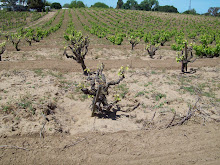
Oakley is home to 100-plus-year-old plantings of Rhone varietal vines, and you would not believe the number of old-skool farmers who pronounce “care-een-yawn” as “care-again.” Not a big deal; I know what they mean, and I’ve heard just as many misspeakings in Napa tasting rooms (“Rye-zling,” “Vee-oh-yay,” “Mare-it-TAJ.”) Hey, it’s all good. We’re talking about a beverage here, and when said bev comes from grapes grown from these century-old gnarly vines, call it what you want; just don’t call me too late for tasting.

Kath and I have tasted varietally bottled Carignane; it’s cool as an experiment, but the real deal is what this grape brings to the party in mixed company. Like some people at a mixer, Carignane can be acidic; it can be colorful. And by itself, it can be downright lonely.

When the old Iberians brought the cuttings over from the old country to the Delta here, who would have thought that the folks who wanted Zin, Mataro, Cinsault, and … yes … Kerrigan, would ever have thought of a Bizarro-world Universe wherein this prolific grape keeps giving the love? Over the last several months, we’ve tasted a lot of CoCo juice; “Kerrigan” has been a key component in a lot of it.

Not that grammar or pronunciation was ever the deal with this grape. No matter how one pronounces “Carignane” – and whether you decide to ditch or keep the extra “e” when writing about it – around Oakley, the vines are old, they’ve taken hold, and their story should be told.

A while back, Eric Asimov of The New York Times quoted winemaker Joel Peterson of Ravenswood Cellars, talking about Carignane vines: “All you have to do is plant them in the right soil, in the right climate with good exposure to the sun, keep the yields down, and then wait 80 years for the vines to become old.”

Yep, cultivation of Kerrigan is a walk in the park.

Speaking of walking, Kathy and I have seemingly meandered full circle with this blog, the genesis of which was the wonderment we first experienced 10 months ago when we realized that wines we had been drinking for decades have been made from century-plus-old vines in our newly adopted city in Northern Cali’s far East Bay. You can’t throw a cork (or preferably, a screw cap) around Oakley without it landing in an old-skool grove of 19th-century Mourvèdre, Zinfandel, Petite Sirah or, yes, Kerrigan.

Kath was reminded of our fascinating CoCo oenological education when she happened, while driving home from work this week, to see workers out in the vineyards pruning the vines in an effort to shear them of new shoots and canes, in anticipation of bud break and yet another crush several months hence. Nice to see that these superannuated vines are alive and well and still producing, even if they do need a little bit of assisted living in-patient care once a year. Circle of life indeed.

Our pal Randall Grahm, he of the “I love you! I hate you! You’re perfect! You’re nuts!” relationship with our ‘hood gives today’s post a bissel closure with his 2008 Bonny Doon “Cunning,” an old-vine Contra Costa blend of 61% Carignane and the rest, Mourvèdre. As the name suggests, it’s a sly little beast of a bottle: It’s got the bright cherry red color of a young Beaujolais, with the fresh Gamay brightness of cherry fruit continuing on the nose. On the tongue, it’s very nimble, with nice acidity dancing around before sitting one out with a refreshingly light finish. The 2008 Cunning is a nicely stylish quaff, this fox.

Also, props and thanks to the folks at Cline. I mentioned last time about our corked bottle of 2007 Heritage Zinfandel. I gave them a call this week, and they were so apologetic, they offered to ship out a bottle of the 2008 (the 2007 is long gone) at no charge. It arrived yesterday. Class act.

Sunday, January 23, 2011

“Heritage”


That’s a word that gets bandied about with alarming frequency. Used to sell everything from real estate to oldee tymee pharmaceuticals, “heritage” seems designed to evoke a continuous, cherished, burnished passing of the proverbial baton through the generational ages.

“Heritage” often gets comingled with the definition for “history,” and when it comes to wine, the two seemingly synonymous words might generate some confusion. The best that I can do right now, in our newly adopted 11-year-old city of Oakley, is to discern that, while Oakley has a history, the remaining grape growers tending the “historical” old vines in the ‘hood have a heritage.

Oakley has been a municipality for just over a decade, but was settled as a town well over a century ago. Portuguese and Italian immigrants to the area established a bit of the Old Country here, planting the joint to wine grapes, fruit orchards, almonds, pistachios and anything else that might take root in the sandy soil a mere fog’s drift from the San Joaquin River. As mentioned in an earlier post, it was a railhead, perfect for shipping produce (especially coveted varietal wine grapes) back east to big-city compatriots for their home winemaking.

I know that the Cline family name has not exactly been missing from this blog, but, see, that’s where the whole “heritage” vibe makes a great, big, splashy and much-deserved entrance. When Fred Cline was growing up in Southern Cali, he’d spend summers with grandpa Valeriano Jacuzzi (yep), learning at the old man’s T-vine about Oakley ag in general, and how to make wine from the Old World varietal plantings in particular. Fred founded Cline Cellars in 1982, and although he moved from Oakley to build a new, modern winery up in Sonoma, the Cline commitment to Oakley fruit is unwavering. Extensive land holdings include Big Break, Bridgehead and Live Oak vineyards, named for Oakley streets (though I suspect that the streets in an 11-year-old city might have been deferential to the erstwhile Cline presence).

Kath and I have tasted and posted about assorted vintages of these vineyard designates. But when Kathy discovered a bottle of the Cline “Heritage” Zinfandel, blended from fruit from the three Oakley food groups, we had to do the do. Live Oak, Bridgehead and Big Break are plots just two miles from each other, and these three vineyard parcels have been Cline family mainstays for decades. The 2007 Cline Heritage Zinfandel is one of the final Cline bottles in our stash, and unfortunately this prize was corked; the aroma of damp cardboard was the first thing to greet us. The corkiness burned off somewhat with time in the glass, and what remained wasn’t enough to overpower the obvious well-knit structure and hefty flavors. It’s a deep, dark monster to the eye, almost reminiscent of a Petite. Despite the unfortunate initial aroma of this particular bottle, the wine exhibits an obvious elegance lurking in the nose, with notes of currant and other concentrated dried fruit. On the tongue, there’s an otherworldly viscosity and rich unctuousness enveloping flavors of tar and oak. Tellingly, the finish on the 2007 Cline Heritage seems virtually never-ending; it goes on and on. Almost like the winemaking heritage of the Cline family itself.

Sunday, January 16, 2011

Great Expectorations


Had a really nice chat with Tim Coles, Cali honcho of The Grateful Palate, an Australian-based network of assorted worldwide wine labels and brands. The brands and labels sheltered by the Palate bumbershoot changes, ebbs and flows, but it’s all good when an Aussie label deigns to give love to our ‘hood, even if only fleetingly.

You must be sick of us writing about the Evangelho Vineyard, up north of us in Antioch.

Owner Frank Evangelho now lives in Pismo Beach, hundreds of miles south of the vineyard. But here’s the deal: Frank Evangelho always seemed to find a block of great old-vine Carignane or Mataro that wasn’t booked to a major client, and that could find its way into a garagiste’s effort. Dave Parker got the call for his Parkmon label, and I’m guessing that winemakers Doug Danielak and Chris Ringland from R Wines must have received a similar Bat Signal for the 2006 harvest.

“R Wines” is a bit of a tentative label under the Grateful Palate ‘shoot at this point in time, and the suspicion is that R may, or may not, make way for something bigger. In the meantime, in between time, ain’t we got fun checking out this CoCo wine from the neighborhood?

R released a couple of Evangelho Vineyard wines in 2006, their last vintage from this property, though, as Tim says, “Never say never.”

“Amaze” from 2006 is 100% Evangelho Mourvèdre, while the 2006 “Amazed” is a 50/50-blend of Mourvèdre and Carignane from the Evangelho property. That’s the one that Kathy found on Wine.com. It was spendier than other Evangelho bottlings we’d searched out from other producers, but, like land, they’re not making it anymore. And, with this being the year 2011 already, this baby has almost a half-decade of age on it already. R Wines’ 2006 “Amazed” California exhibits a deep blue/black color. On the nose, it’s scented to plum and other red stone fruit, with notes of tar, tobacco and cedar. The palate notes a real elegance and purity of balance that’s different from other Evangelhos we’ve tasted from other producers, with lots of smoky wood on a long, long finish. It’s 16.5% alcohol, surprising considering the wine’s refinement in the glass. Come back soon, Amazed.

Sunday, January 9, 2011

Dead End


Since we started this blog last April, Kathy and I have made a few interesting discoveries about the grapes and growers around Oakley, and we’ve drunk some delicious wines made from our local fruit from these century-plus aged old vines. We’ve had some revealing interviews with some of the growers, and it’s been fun to track down some bottles made by the winemakers to whom these growers sell. “Drinking our way through the neighborhood” is our term for this little endeavor.

But we’re starting to get to a point several months into this thing wherein the leads start to dry up and the investigation, as it were, slams into the proverbial brick wall. We have several bottles in our cellar containing wine made from CoCo grapes, but in a couple of instances, I’m having a heck of a time getting someone from the particular wineries to return my calls or e-mails.

Such is the case with Trinitas Cellars, a label I’ve written about a few months back. Trinitas was started by Matt and Erin Cline, in partnership with Tim and Steph Busch and Ray and Bette Rodeno, when Matt left the family biz, Cline Cellars, to go out on his own as winemaker. As noted in past posts, Matt and Erin sold out their interest in Trinitas to current owners the Busches, and went on almost immediately to found 3 wine company, which Erin and Matt run today.

We have at least four bottles of Trinitas varietal wines made from Oakley grapes, and I can’t get anyone on the phone to talk to me about them. Trinitas even has a national sales manager, my messages haven’t been returned. Ah well, c’est la vino!

Our Trinitas bottlings are from the 2006, 2005 and 2004 vintages, with the ’04 bearing Matt’s winemaker signature on the label. The later two vintages bear those of Tim and Steph, as the then-new proprietors. But based on the timeline of the buyout — Christmas 2006 —, with the ‘05s in the barrel and the ‘06s in the tank, it’s pretty clear that Matt made all these wines before transferring his stake.

I’d love to hear from someone at Trinitas about any changes post-sale. Matt, of course, is so passionate about Oakley fruit that I wonder if the new regime still sources from growers around here.

In the meantime, it’ll have to suffice for us to blow the dust off a bottle of Trinitas Cellars wine made from old-vine grapes by the old guard.

The Trinitas 2004 Old Vine Mataro is an Oakley love-fest blended with single-digit percentages of Black Malvoisie (an old-skool synonym for Cinsault), Petite Sirah and Alicante Bouschet. In the Riedel, it’s all deep, though translucent, cranberry. The Ocean Spray vibe continues on the nose, joined by whiffs of blueberry and spicy cocoa. The mouthfeel echoes the nose, with lots of tart, superbright small-berry fruit. There’s nice balanced acidity with a touch of earthiness on a subtle medium-length finish.

Sunday, January 2, 2011

Absinthe, You’d Better Make This Heart Grow Fonder


See ya, Old Man 2010; don’t let the door rupture your colostomy bag on the way out.

It’s late morning on December 31, 2010, and I’m here at the keyboard, reflecting, sans vino, on the past year. A few local vineyard mysteries solved, some nice wines from local grapes drunk; but, man, what a year of upheaval. Kathy has worked for three companies this year alone: the firm that relocated us to Oakley from Seattle in the summer of 2009; another company that cut her medical benefits the day she lost her job; and her current employer: a much more prestigious company, but the gig came with a cut in pay and benefits.

Our city of Oakley in East CoCo County is the literal “suburban bedroom community.” It’s a commuter’s Mecca, if by “Mecca” one means bowing one’s head to the steering wheel five times daily and, raising one’s head to the vehicle’s roof, loudly exhorting to your deity of choice. Highway 4 sucks, but it’s the only game in town. The Bible, Torah or Quran just doesn’t seem to help, no matter how long you scream into the sun visor at rush hour. And in our locale, much as city government would like to bolster local business, the reality is that any available gigs are in the retail sector. Not much call for a former stand-up comic, magician (past lives) or, (most recently), advertising copywriter, editor and prufreeder. Samples avale-able on re-kwest, natch.

2010 saw Kathy hear from old friends in Utah who are justthisclose to losing their house to foreclosure.

2010 saw our Seattle-area Woodinville wine pals, who, if Kath and I were feeling blue, would send a “Wine tasting tomorrow?” e-mail at just the right time. We found out that one of them lost their job due to the proverbial economy. They bought us a Didier Daguenau Sauvignon as a parting gift last year. The plan, as always, was to share it with them in our new house, but do not know when that can make economic sense for anyone. FYI: It’s still chillin’ at das crib, guys.

2010 saw other friends lose their dream ranch in Eastern Washington, where they were raising goats, chickens and a new baby daughter. Job precariousness necessitated their putting the homestead up for sale and relocating back to the other side of the Cascade Mountains, on a scaled-down version of their dream in suburban Woodinville.

2010 saw our neighbor, an investment banker no less, list his former model home on MLS as a short sale.

Working in SF, Kathy happened to pick up a couple of tickets that the Bay Area Rapid Transit (BART) system was handing out at select stations. These were Sat/Sun-only tix, designed to encourage folks to come to the city just before Christmas. BART’s fares are mileage-based, like London’s Tube, but these tix were good for a one-way excursion, regardless of distance. Ever since leaving the Pacific Northwest last year, we had been jonesing for oysters. We’d been disappointed that any seafood in the East Bay had been “frozen for quality” when Seattle salmon was being given away up north. Heck, even the local “oyster bar” in Brentwood offers only the dinner-plate-sized Pacifics.

December 18, we drove to BART and rode to SF for three-dozen raw Olympia oysters and a bottle of Muscadet sur-lie. Absolutely glorious. Missed that so much.

We jumped on the Alameda ferry; the terminus is minutes from Rosenblum Cellars. St. George Spirits used to be located right beside the Rosenblum crib. They are not now. We disembarked the ferry and walked for 20 minutes to the new distillery, now call Hangar One for their eponymous Vodkas. We did a tasting, and the purity of the infusions is exquisite. We paid a little extra for the tasting of their “Absinthe Verte.”

Historically, Absinthe is that funky spirit infused with the dreaded herb wormwood which contains a supposedly addictive drug known as “thujone,” affecting such subversives as Baudelaire, Modigliani, van Gogh and Oscar Wilde. Bartender, see what the boys in the back room will have! By 1915, it was banned almost worldwide.

In the last month of 2007, St. George became the first American-made Absinthe manufactured here. It’s a gorgeous bottle sporting an oldee tymee apothecary label touting its contents as “Fine Brandy With the Choicest Herbs,” including star anise, mint, lemon balm, hyssop, meadowsweet, basil, fennel, tarragon, stinging nettles, and, last but not least, the storied, previously banned, wormwood. I’m more worried about the stinging nettles, but after 2010, am more than ready for wild imaginings.